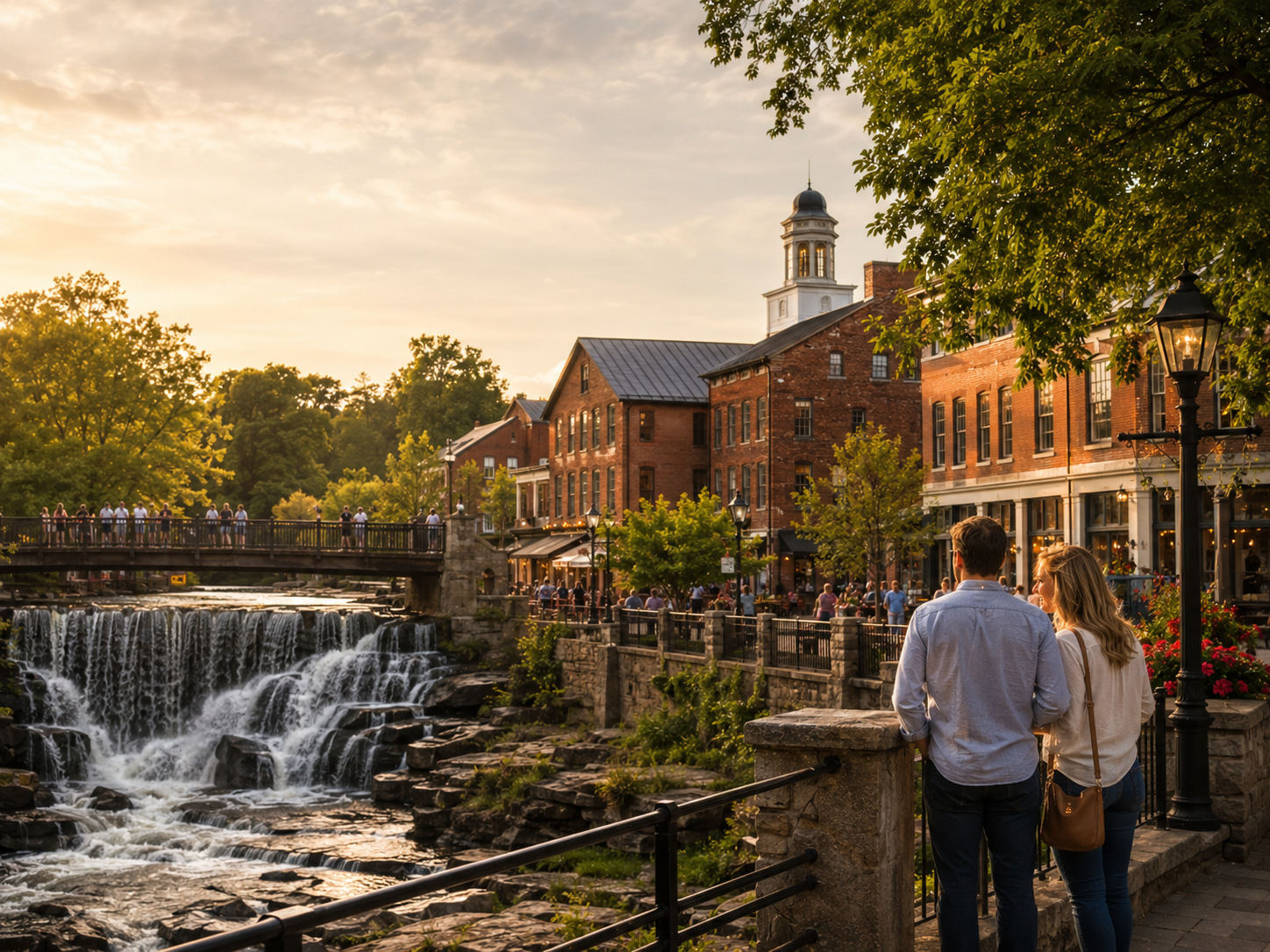
A Village Born from Falling Water
The story of Chagrin Falls begins where so many American frontier stories do — at the water's edge. In 1833, Seabury Ford, a lawyer and future Governor of Ohio, and his brother Ebenezer arrived in the Chagrin River Valley and recognized something remarkable: a natural waterfall powerful enough to drive mills, in a valley rich enough to sustain a community. They platted the Village of Chagrin Falls that same year, and the settlement that grew up around that cascade would prove to be one of the most enduring small towns in all of Northeast Ohio.
The Chagrin River waterfall at the heart of the village was not merely scenic — it was industrial muscle. Through the 1830s and 1840s, gristmills, sawmills, and woolen mills rose along the riverbanks, drawing craftsmen, merchants, and families westward from New England and New York. The distinctive character of those early settlers — industrious, civic-minded, architecturally thoughtful — left an imprint on Chagrin Falls that is still visible today in the Federal and Italianate storefronts lining North Main Street.
Incorporation and Early Growth
Chagrin Falls was officially incorporated as a village in 1844, formalizing the community that had been growing steadily for a decade around the falls. By mid-century, the village boasted a post office, churches, a public square, and a thriving commercial district. The completion of a plank road connecting Chagrin Falls to Cleveland in the 1850s opened regional trade and gave local merchants access to the growing city market just twenty-five miles to the west.
The Civil War era tested the village, as it did every American community, but Chagrin Falls emerged intact and growing. The second half of the nineteenth century brought additional manufacturing, new civic institutions, and eventually the railroad, which turned the village into a more connected — though never sprawling — regional hub. Throughout this period, the waterfall remained the defining image of the community, celebrated in local newspapers and admired by visitors who made the journey out from Cleveland.
A Town That Chose Character Over Growth
What distinguishes Chagrin Falls from dozens of comparable Ohio towns is a quiet but firm choice made generation after generation: to grow carefully rather than quickly. When the great suburban expansion swept across Cuyahoga County after World War II, the Village of Chagrin Falls largely held its ground. Residents and civic leaders resisted the kind of commercial strip development that erased the downtowns of neighboring communities, and the result is a village center that looks today much as it did a century ago — scaled for people, not for cars.
The waterfall that Seabury Ford recognized in 1833 still tumbles through the center of town. The Popcorn Shop on the main street, family-owned for generations, still sells popcorn the old-fashioned way. The limestone and brick storefronts that line the business district are still occupied by independent merchants. This is not an accident — it is the outcome of sustained, intentional community stewardship.
Your HomeTown Chagrin Falls and the Modern Era
Your HomeTown Chagrin Falls (YHTCF) was established as a 501(c)(3) nonprofit organization to formalize and strengthen that long tradition of stewardship. YHTCF serves as the organizational backbone of the village's civic and cultural life, producing eight signature annual events, operating the village Visitors Center at 83 North Main Street, leading beautification efforts through the planting and maintenance of seasonal flowers and greens in 52 downtown urns, and working to connect visitors, residents, businesses, and donors around a shared commitment to the village.
The organization reflects a truth that Chagrin Falls has always understood: that a place this special does not maintain itself. It takes people who show up — as volunteers, as donors, as event organizers, as neighbors who plant flowers and wave strangers in the right direction. YHTCF is the community's way of making that effort organized, sustainable, and celebratory.
Annual Traditions That Define the Village
No account of Chagrin Falls history is complete without its living traditions — the annual events that mark the seasons and bring the community together year after year.
Blossomtime is one of the village's most beloved spring celebrations, welcoming the return of warmth with outdoor festivities, live music, and the flowering of the downtown district. It is the kind of event that Chagrin Falls does exceptionally well — intimate enough to feel personal, vibrant enough to draw visitors from across the region.
Each December, the Holiday Lighting Ceremony transforms the downtown into one of the most photographed winter scenes in Northeast Ohio. Thousands of lights are strung through the trees along the falls and the main street, and the community gathers for the ceremonial flip of the switch that marks the start of the holiday season. The sight of the illuminated waterfall on a cold December night — mist rising, lights reflecting off the water — has become one of those images that defines Chagrin Falls for people who have never visited and draws returnees year after year.
Beyond those signature events, YHTCF produces Chagrin on Tap (a celebrated craft beer festival each spring), the Home & Garden Tour (an annual peek inside some of the area's most beautiful private homes and gardens), Boo on the Boulevard (a beloved Halloween tradition for families along the main street), and Deck the Falls (the full holiday season programming surrounding the winter lighting). Each event is organized by community volunteers and reflects the same spirit of personal investment that has characterized life in Chagrin Falls since the 1830s.
Looking Forward
Chagrin Falls enters its third century as a village with something rare: a clear sense of what it is and what it wants to remain. The falls still fall. The downtown still belongs to independent merchants. Neighbors still know each other. And Your HomeTown Chagrin Falls continues its work of ensuring that the community Seabury Ford platted along the river in 1833 remains, well into the future, exactly the kind of place worth protecting.